The Olmecs: A History from Beginning to End (Mesoamerican History Book 1) by Hourly History
Author:Hourly History [History, Hourly]
Language: eng
Format: epub
Publisher: Hourly History
Published: 2019-06-16T00:00:00+00:00
Chapter Five
Were-Jaguars and Feathered Serpents
âMany later Mesoamerican civilizations trace their ultimate ancestry to the Olmec.â
âJohn S. Henderson
What we know of Olmec religion comes entirely from archaeological excavation. Many figures and statues have been recovered as well as decorated pottery which seem to show supernatural beings, and these have been assumed to be some kind of deities which were important to the Olmecs. It appears that the Olmecs had many gods, though their religion has been described as simplistic by some scholars because they seem to have had relatively few deities compared to the later Maya (who worshipped more than 250 different gods) and the Aztecs (who believed in a pantheon of more than 1,000 gods).
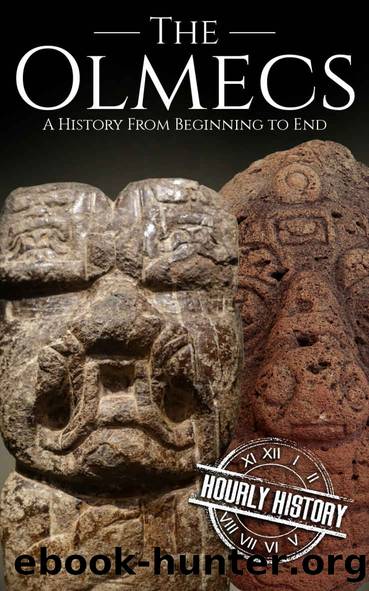
One of the most often repeated deities in Olmec art is a being which shows a combination of both human and jaguar features, often depicted as having a human body and a jaguar head. This being is often called the âwere-jaguar,â and scholars have speculated that the Olmec were fascinated by the power and strength of the jaguar and believed that some people could physically transform themselves (at least partly) into jaguars. Alternatively, it could be an allegorical attempt to suggest that some people could take on certain aspects of the jaguar, perhaps including its courage, cunning, and ability to see in the dark.
Some people have suggested that the were-jaguar figures represent Olmec shamans who perhaps wore jaguar skins and heads as part of their ceremonial costume or who were believed to be able to transform themselves into jaguars. The motif of the were-jaguar is present in many forms of Olmec art, and its presentation is generally very consistentâa human body is attached to a head which has an elongated, cat-like snout and almond-shaped cat-like eyes. However, there are exceptions. For example, most of the colossal stone heads recovered from Olmec sites are presumed to be portraits of actual people, most likely Olmec rulers. But one of the basalt heads shows what seems to be the head of a man with the mouth of a jaguar. This head also features a strange cross over the right eyeâthe cross is a common glyph in Olmec art, but its meaning here is unknown. At least one Olmec statue shows a keeling person holding the body of what seems to be a were-jaguar child (which also incorporates a large cross glyph on its chest). There has been speculation that this depiction of a jaguar-human hybrid is a representation of some royal lineage, where a particular family was either presumed to have descended from a jaguar god, or who perhaps were said to embody characteristics of the jaguar.
There are different versions of the were-jaguar in Olmec artâsome show a human body attached to an almost fully represented jaguar head while others show a human form which incorporates the mouth and ears of a jaguar. Notably, Olmec art which shows the were-jaguar does not include sexual characteristicsâthe human part of these figures could be either male or female, a feature of many Olmec creations which seem to show supernatural beings.
Download
This site does not store any files on its server. We only index and link to content provided by other sites. Please contact the content providers to delete copyright contents if any and email us, we'll remove relevant links or contents immediately.
| Africa | Americas |
| Arctic & Antarctica | Asia |
| Australia & Oceania | Europe |
| Middle East | Russia |
| United States | World |
| Ancient Civilizations | Military |
| Historical Study & Educational Resources |
The Dawn of Everything by David Graeber & David Wengrow(1707)
The Bomber Mafia by Malcolm Gladwell(1622)
Facing the Mountain by Daniel James Brown(1553)
Submerged Prehistory by Benjamin Jonathan; & Clive Bonsall & Catriona Pickard & Anders Fischer(1455)
Wandering in Strange Lands by Morgan Jerkins(1427)
Tip Top by Bill James(1416)
Driving While Brown: Sheriff Joe Arpaio Versus the Latino Resistance by Terry Greene Sterling & Jude Joffe-Block(1376)
Red Roulette : An Insider's Story of Wealth, Power, Corruption, and Vengeance in Today's China (9781982156176) by Shum Desmond(1359)
Evil Geniuses: The Unmaking of America: A Recent History by Kurt Andersen(1352)
The Way of Fire and Ice: The Living Tradition of Norse Paganism by Ryan Smith(1336)
American Kompromat by Craig Unger(1315)
F*cking History by The Captain(1303)
It Was All a Lie by Stuart Stevens;(1300)
American Dreams by Unknown(1285)
Treasure Islands: Tax Havens and the Men who Stole the World by Nicholas Shaxson(1272)
Evil Geniuses by Kurt Andersen(1257)
White House Inc. by Dan Alexander(1211)
The First Conspiracy by Brad Meltzer & Josh Mensch(1174)
The Fifteen Biggest Lies about the Economy: And Everything Else the Right Doesn't Want You to Know about Taxes, Jobs, and Corporate America by Joshua Holland(1126)
